stat counter

Friday, August 5, 2016

MONO LAKE


We stumbled upon a strange beauty last week.  
Francesca and I were  heading west across the Nevada desert.  After crossing into California we saw a mirage of blue to our left, a cool respite from the scorching heat. A sign said, "Mono Lake".

"Save Mono Lake" bumper stickers were abundant in the 70's. I learned they referred to a huge California Lake that got sucked dry to water the lawns of Los Angeles. Sunrise at South Tufa. I remember the haunting images of strange protuberances rising up from what water remained.
         Last week we drove down to the water's edge and learned the details. Mark Twain called it "America's Dead Sea".  
    Mono Lake wasn't dead when he visited 150 years ago. It was alive in strange ways, an inland sea so high in salt content that few life forms could live there.
    Algae loved it there as did small brine shrimp that ate it. Sea birds by the millions made it their home to feast on the shrimp that swirled above the "tufa". These were the jagged vertical shapes that rose up from the lake bed much like the whimsical forms of a coral reef. Tufas were formed by the bubbling minerals in underwater springs.
  
   
       Its like standing in a dead coral reef rising up from the sea. 

   The lake was continually fed by six streams tumbling down from the mountains. Eighty years ago a problem arose, wealthy Los Angeles was hungry for water. It purchased the water rights to four of these streams and, in 1941, began diverted the most of the lake's fresh water to southern California. This added billions of dollars to L.A. real estate values.
    It also ruined Mono Lake. The water level dropped 50 feet exposing the strange tufas for the first time. The same salt with much less water cause the lake's salinity to rise 250%. Alkalinity rose as well and much of the lake's life died.

     Further, the people who had depended on the diverted streams had their lives "dry up" as well.
This led to the "Save Mono Lake" movement in the 1970's.  
     The lake has been improved, somewhat. 40% of the original water courses have been restored. The lake is now about 30-feet below its natural level and less tufas are exposed.

    Remember the movie, "Chinatown"?  It's tale of greed, incest, and murder was centered around the  City of Angels' thirst for water in the early 40's.


     Mono Lake is a strange and sad place to visit, like any natural resource harmed by man. It is not unlike Florida's Everglades which has had much of its water cut off so more houses can be built and more sugarcane  grown.

    Mono Lake tastes much more salty than an ocean. You easily notice a briny slime rubbing its water between your fingers.
Its all there to see, the green algae being eaten by bugs and shrimps who are being devoured by abundant birds.  I guess we were seeing what the partial restoration has done.

     It makes for a solemn visit. I couldn't help looking up at the sad stone man standing far out in the lake.  If he had any questions, I had no answers.


                             ___________


Tuesday, August 2, 2016

CAMP TOPAZ, AN AMERICAN TRAGEDY

      Imagine this nightmare happening to you. Government officials tack up posters that say, "Everyone in your neighborhood will be relocated. You have three weeks to dispose of everything except what you can carry". 
    Buses arrive. You, your wife and kids, and even grandma, are forced to climb aboard. You are driven away from the home you will probably never see again.

     Two days later you are rolling through a desolate, sun-scorched desert. In the distance you  see the guard towers of a prison. Your bus passes through a barbed-wire fence that surrounds 430 tar-papered barracks. This is your new home. 
  
    You will live here for years. You and thousands of others endure this because your ancestors came from an unpopular country. 


     This nightmare came true for 110,000 Japanese- Americans in 1942, at the beginning of World War II.


   I knew about it and knew it was wrong but never gave it much thought. This ended when we discovered the Topaz Museum in Delta, Utah last week.

 
Camp map


  The Topaz Japanese-American internment camp was one of ten  spread across desolate places throughout the      United States.
     For three and a half years, 11,000 people lived in the camp located a few miles northwest of Delta, Utah, a rural Mormon town. It is far from everything, 125 miles south of Salt Lake City. Most of Topaz's internees came from the San Francisco Bay area. Forty-five percent had lived in my wife's hometown, Berkeley, California.
 
   Museum sign
  
     This sad part of our country's history was slowly being forgotten when a local high school English teacher, Jane Beckwith, took up the cause.  In 1982 she had her journalism students do research and write about the camp that closed thirty-six years earlier. They soon recognized that this was an important part of their own history and rallied to preserve it.
     Ms. Beckwith led a thirty-three year effort to create one of the most outstanding small, historical museums in the country. Francesca and I got to meet Jane and thank her for all she has done.
 
     
     Through decades of pleading, begging, and generally espousing, "We have to do this!",  Ms. Beckwith and her crew cobbled together nearly $3 million in grants, gifts, and donations. They were able to preserve 630 acres of the camp's remains and build the Topaz Museum on Main Street in Delta. 
    As you can see, the building and its interior are magnificent designs. After the three-decade effort, it opened last year.


WHEN WORDS WEREN'T ENOUGH

   
   It's inaugural exhibit is "When Words Weren't Enough", art created by people who were imprisoned there. 
  
    Many of the people interned were professional artists and art instructors such as Mine Okuba and Suiko Hikami. They created a body of work that told Topaz's story. Here are a few of the 125 pieces of art on paper that make up the museum's current exhibit.


                                                                 Two Coyotes


  Camp Topaz's Japanese-Americans artists, led by UC Berkeley instructor Churu Obata, created an art school for the internees' benefit. 
  
 
 Many of Delta's citizen's came to the shows.  A year after the camp opened, it became apparent that the new guests were not a threat and were in fact, good neighbors. The guard towers came down and the internees were allowed to visit the town.


 Part of one of the barracks has been re-created in the back of the building.  


   A real one was moved to the garden at the end of the property.


  Imagine living in this room. You are one of three families. The only privacy is afforded by sheets hanging down between the metal cots. There is no furniture other than what you can make from wood scraps.

      The art exhibit will end in September when the permanent collection will be installed. It will focus on the camp's history. The collection will include a dozen art pieces chosen from the current show.
    Delta is far from any interstate highway but when people learn about the Topaz, a rare desert gem, they will come.
                     
     We all need to learn the lessons that Topaz teaches. In these challenging times it is not hard to imagine it happening again.
                   _______________________ 


 Close to Home
Note: 
 -A couple of days after our Topaz visit we stopped by to see our niece and her husband, Daniel Bissonnette. We learned that Daniel's grandmother, her parents, and many of his other Bay Area relatives were imprisoned at Camp Topaz during WW II.  

-473 of the incarcerated Japanese Americans were allowed to leave to join the US Army. They formed a highly effective combat team that fought in Europe. Their unit was one of the most highly decorated in WW II. Fifteen of them were killed fighting for our country.
         
                         Gold star mothers incarcerated     at Camp Topaz

-Not a single Japanese American was prosecuted or convicted for espionage against the U.S.
                                  _____________________

Saturday, July 30, 2016

CANYON LAND


      Utah is much more than mountains and Mormons. Driving down from the Rockies we were embraced by its colorful canyons that had been carved by the Colorado River. 


 From mountains to mesas, breakfast by the Colorado
 
    We spent a day hiking through Canyonlands National Park then watch the sunset with our new campground neighbors, Larry and Melanie.    They retired young spending half of the year living on their sailboat in Mexico. The summers are spent roaming our country's cool mountains in a camper similar to ours. 
      
Like us, they converted a Toyota van into a home on wheels. They have bikes on the back and that pod on top?  It holds their inflatable kayak.
       Mel and Larry love to wander and can afford their no-work lifestyle. As they told us, “It costs much less to live in Mexico and here, camping is just twelve bucks a night”. The former airline manager and sit-com producer have lived this way for years. If they ever settle in one place it might be on a houseboat in France.


    The four of us enjoyed hiking in the park which is a lot like the Grand Canyon, a hundred miles southwest.

     Wind and rain have carved up this part of the west in beautiful ways. Just north of Canyonlands is Arches National Park.  Although neighbors, the two parks are quite different.  In the first you're looking down into huge voids.


 In Canyonlands they'll let you drive your car 1,400-feet down to explore 100 miles of the canyon's inner rim.  We watched an ant-size car traversing these zig-zags hoping they didn't make a mistake.

When you're in Arches, you're tilting your head up a lot.


 This formation is called "The Three Gossips"


    In Arches you are high on a mesa with over 400 spans, dramatic negative spaces, sandstone worn away by wind and water. 

             Francesca climbing down from her perch
 
    We hiked to a few in the 105 degree heat.  By two p.m, we were ready to cool down in the nearby Moab library. The popular place was packed. We learned it got a 2009 award for being our country’s "best small town library”.  The award described it as  “Moab’s living room”. 
   This town, like Boulder, is a magnet for people who enjoy extreme outdoor activity like hiking, mountain biking, and boating. It’s next to the Colorado River so it seems there are more river rafts than cars.
   It was time to tell the magnificent muddy river goodbye. The Colorado was turning south to enter the Grand Canyon and we were continuing west.
   Note:  Unfortunately, we're doing our best to destroy the big river. You may want to watch "The Death of the Colorado" on the Discovery Channel, Thursday, August 4th.
 
   We decided to spend the rest of the sweltering day pushing our air-conditioned van further.  The two of us expected to be passing through flat desert for hundreds of miles, until we reached California’s Sierra Mountains.  I thought I might see see a Mormon dad crossing the road with his six wives and twenty-nine children.  

    Neither happened. The fantastical “canyon lands” continued for hours until it became mountainous ridges with dry, desert valleys in between. 
    The evening's long excursion was totaling entertaining.  We had close up, slo-mo view of all we’d been admiring from 30,000 feet on annual flights to the Bay Area. Most of Francesca's family lives there.  


   We were now far from interstate highways. Our path took to a national park we'd never heard of ("Great Basin") 


and, the next day, through small towns like Delta, Nevada. 


   This place -like many others- had a small history museum run by the town's elders. These cool collections exhibit items you’d never see in a big city museum and you can pick them up! 
   Delta's did a decent job of covering the 10,000 years when Native Americans were here. Their lives were relatively simple, arrowheads and pottery shards were displayed. Nomadic Indians did not require furniture or collect antiques.

   This museum's focus was on what white people had done in this area after they destroyed the pesky Indians. For many years they had a gathering place for the U.S. army veterans who fought them.

    The citizens of Delta re-created a general store in their museum and
held on to their early telephone operator console.
     There was plenty from my early days too.  I saw the dentist's drilling apparatus that tortured me as a kid and the machine that x-rayed my new shoes (and my feet inside).  I'd step into  one every time
my ma took me to Landau's Shoe Store in Miami Springs. From all that radiation it's a miracle I still have ten toes.

     As we were leaving the hostess asked us if we'd seen the museum next door. When we told her we had not, we learned about Delta's biggest story.  
    At the beginning of WW II, 10,000 Japanese-Americans were forced to leave their California homes to live in a desert prison just outside of town.


More on "Camp Topaz" when the Grove Guy returns. 
           ________________________

Friday, July 29, 2016

TOP O' THE ROCKIES

  Boulder, Colorado is at the base of Rocky Mountain National Park. This national treasure is one of the few places where you can drive up, up, up to reach snow in July. Swooping though the two-mile high alpine tundra feels like flying.
    We soared in our van for a hour then wound our way down.
Soon we were camping in the green meadow where the Colorado River begins.
  The gentle brook in which we we dipped our tired feet gathers enough volume to carve canyons from here to Mexico. The Grand Canyon is only one of its many creations.  Our route west kept us next to the mighty river for the next three days.
    Sauntering into the woods we passed a herd of elk, fly fishermen, and later, a 1000-pound moose. 


You can't ignore the millions of dead pine trees in this park and all over the west. Drought and warmer temperatures have allowed the deadly pine beetles to kill millions of  them. Fifty years from now the dead forests will be green again, replaced by other species.

  We learned why the trees are skeletal at a park ranger campfire performance.  The young man wearing a Smokey hat also talked about the elk that were grazing nearby. He brought out two skulls attached to magnificent antlers.  Every fall the bulls compete for the love of the “women”. They do this by smashing head-on into each other until one of them says “Eeuh!” (elk for “Enough!”).  These two unfortunately got their antlers locked together. They starved to death that way. 
    The things we do for love.

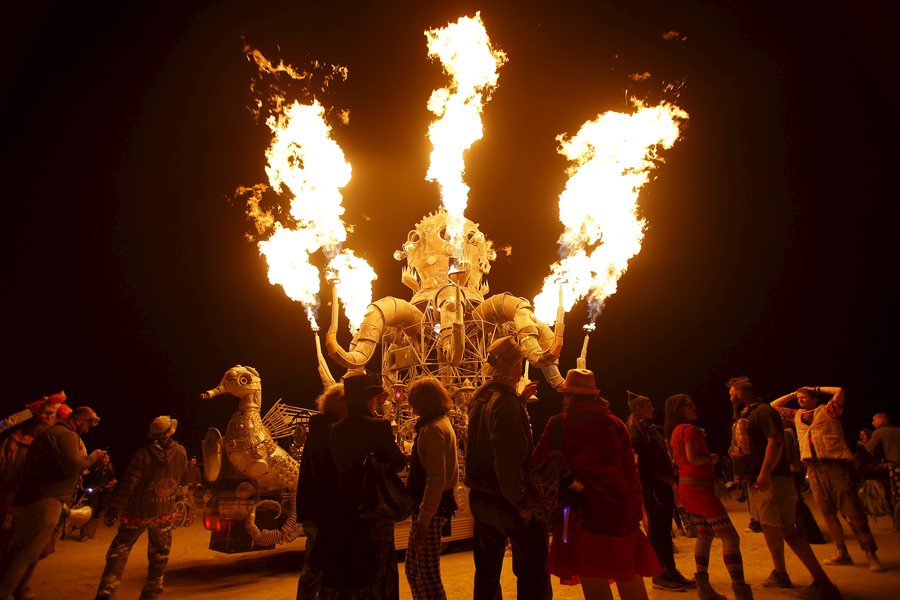
    Francesca and I are long past the initial mating ritual stage. We’re now exploring the west on our way to California. We will spend a few weeks there, until it’s time for Francesca to return to her Miami job. I plan to stick around for Burning Man, a fantastic festival taking place in the Nevada desert every August. I haven’t been able to get a ticket yet but if I am persistent enough, I think I’ll be dancing under the stars with 70,000 other “burners” a month from now.

               ___________________________